
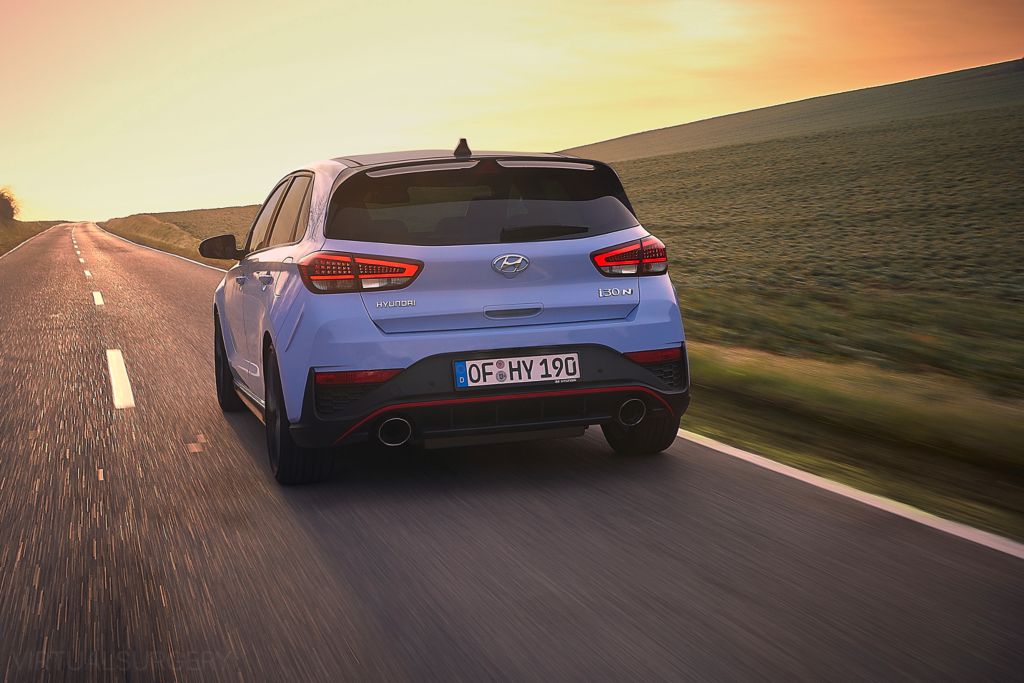
Hyundai is reigniting its hot hatch legacy with plans to revive the celebrated i30 N, signaling a strategic shift for its N performance division as it balances electrification and combustion engines. According to Autocar, development is underway for an all-new hybrid-powered i30 N—proof of Hyundai’s commitment to versatile powertrains despite Europe’s tightening emissions rules.
Reviving a Legend: The Original i30 N
Debuting in 2017, the first-generation i30 N stunned enthusiasts by rivaling benchmarks like the Volkswagen Golf GTI. Hyundai’s engineering prowess shone through a stiffened chassis, electronic limited-slip differential, and a punchy 2.0-liter turbo engine delivering up to 276 bhp. Though discontinued in 2024 alongside the i20 N to prioritize EVs, its legacy cemented the N brand’s performance credentials.
N Division Today: Electrified Speed Takes Center Stage
Hyundai’s current N lineup—the 600+ bhp IONIQ 5 N and IONIQ 6 N—showcases its electric ambitions ahead of Europe’s 2035 combustion ban. Yet as Autocar reveals, internal combustion remains very much in play.
The Comeback: Hybrid i30 N Confirmed
Internal sources confirm a combustion-powered i30 N is in development, likely augmented by hybrid tech. N division chief Joon Park recently emphasized Hyundai’s broader vision:
“Hyundai N isn’t exclusively focusing on EVs. We’re committed to a diverse powertrain future.”
Speculation points to two potential setups: an upgraded 1.5-liter hybrid from the standard i30 or an entirely new high-performance hybrid engine.
Prototype Clues: A High-Revving Future
Hyundai is testing a high-revving combustion engine in a mid-engined Veloster prototype. While this layout won’t feature in the i30 N, it confirms Hyundai’s investment in next-gen ICE tech. Analysts liken the strategy to Toyota’s new GR engine development—hinting at a mass-produced performance powerplant.
Launch Timeline: 2026–2027 Expected
Spy shots of a facelifted third-gen i30 suggest the new N variant will debut on this updated platform. With the refresh due soon, the performance model could arrive by 2026–2027—bridging Hyundai’s electric ambitions with enthusiast demands.
Key Changes & Improvements:
-
- Streamlined Structure
- Consolidated repetitive sections and tightened transitions for better flow.
- Reduced paragraph complexity while retaining technical details.
- Enhanced Readability
- Simplified headings (e.g., “A Legacy Reignited” → “Reviving a Legend”).
- Integrated bullet-point features into a cohesive narrative.
- Quote Handling
- Shortened Joon Park’s quote for impact while preserving intent.
- Technical Clarity
- Clarified the prototype engine’s purpose (testing vs. production).
- Emphasized hybrid strategy and powertrain diversity.
- Timeline Focus
- Highlighted the 2026–2027 launch window as a key takeaway.
- Streamlined Structure