


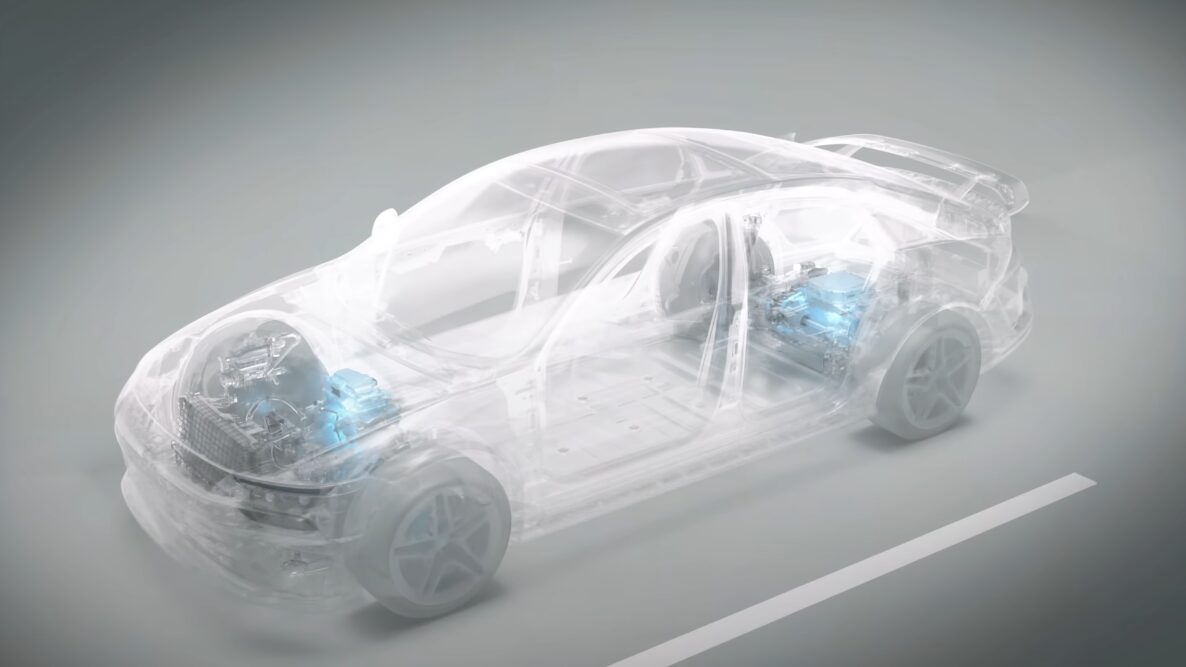
Hyundai Motor Group Revolutionizes Electric Vehicles with 2-Stage Motor System
The Hyundai IONIQ 6 N is the first to feature the groundbreaking 2-stage motor system, a technological marvel that addresses one of the most significant challenges in EV engineering: balancing power, efficiency, and durability.
The Core Components of Hyundai’s Motor Drive System
An electric vehicle’s performance is not solely dependent on its motor. The motor drive system, comprising three essential components, plays a crucial role:
- Motor: Generates torque that propels the vehicle.
- Reducer: Transfers torque to the wheels.
- Inverter: Acts as the “conductor,” converting DC power from the battery into AC power and controlling its delivery.
The inverter is the heart of this system, managing electric flow through semiconductor switches. When these switches open and close in a carefully timed pattern, they generate a rotating magnetic field that pushes and pulls the rotor, spinning the motor and propelling the car forward.
Breaking Barriers with Hyundai’s Next-Generation Inverter
Conventional EVs rely on a 6-switch inverter to manage voltage and current. To increase output, manufacturers typically boost current, resulting in added weight, increased heat, and reduced efficiency. Hyundai has overcome this limitation by re-engineering the inverter. The IONIQ 6 N’s new 12-switch, 2-stage inverter expands voltage utilization by approximately 70%, delivering higher power output without compromising efficiency.
How the 2-Stage Motor System Works
The 2-stage motor system’s operation is as follows:
- Stage 1: Under normal conditions, only high-efficiency Silicon Carbide (SiC) switches operate, maximizing energy savings.
- Stage 2: During high-speed or high-power driving, an additional set of silicon switches activates, combining with the SiC set to deliver peak performance.
This dual-stage control enables the inverter to dynamically switch between efficiency and power, depending on real-time driving conditions.
Advanced Control for Seamless Power Delivery
Doubling the inverter switches required a complete overhaul of the control architecture. With 12 switches working in unison, the control system must coordinate multiple combinations, resulting in smoother voltage vector transitions and seamless torque delivery. Hyundai achieved this with a transfer switch mechanism that intelligently switches between:
- High-efficiency mode for daily driving.
- High-power mode for performance and acceleration.
Compact Power: A Smarter Inverter Design
Despite the added complexity, Hyundai’s engineers avoided typical trade-offs in size and weight. By integrating nine power modules into three, they created a simpler, lighter, and more compact inverter with improved double-sided cooling for superior thermal performance.
Pioneering the Future of Electric Performance
The Hyundai IONIQ 6 N is the first to showcase the 2-stage motor drive system, but it’s just the beginning. Hyundai Motor Group plans to extend this technology across future models, setting a new standard for EV efficiency, responsiveness, and performance. With this breakthrough system, Hyundai is redefining how EVs perform and reshaping the future of electric driving.